
Half the travel copy written about Rangiroa puts it next door to Bora Bora. It is not. The two sit in different archipelagos, hundreds of kilometres apart, and getting that straight changes how you book your room.
Quick takeaways
- Rangiroa is in the Tuamotu archipelago, roughly 355 km northeast of Tahiti, about an hour by plane from Papeete.
- Two villages, Avatoru and Tiputa, sit either side of the atoll’s two passes. Your village decides your holiday.
- Book half board or a kitchen. Restaurants outside the hotels are few and far between.
- Divers should aim their dates at the marine life they want, not just at the dry season.
The right hotel in Rangiroa is the one on the correct side of the pass for the holiday you actually want. The Avatoru side has the airport, the shops and most of the accommodation. The Tiputa side is quieter and reached by boat. Everything else, meal plans, transfers, whether you get a beach or a lagoon-edge terrace, follows from that first choice.
Where Rangiroa really sits on the map
Rangiroa belongs to the Tuamotu archipelago, around 355 km northeast of Tahiti, and it is the largest atoll in that group and one of the largest in the world. Bora Bora, the island it keeps getting paired with, is in the Society archipelago in the opposite direction. They are not neighbours and you cannot pop between them on a whim.
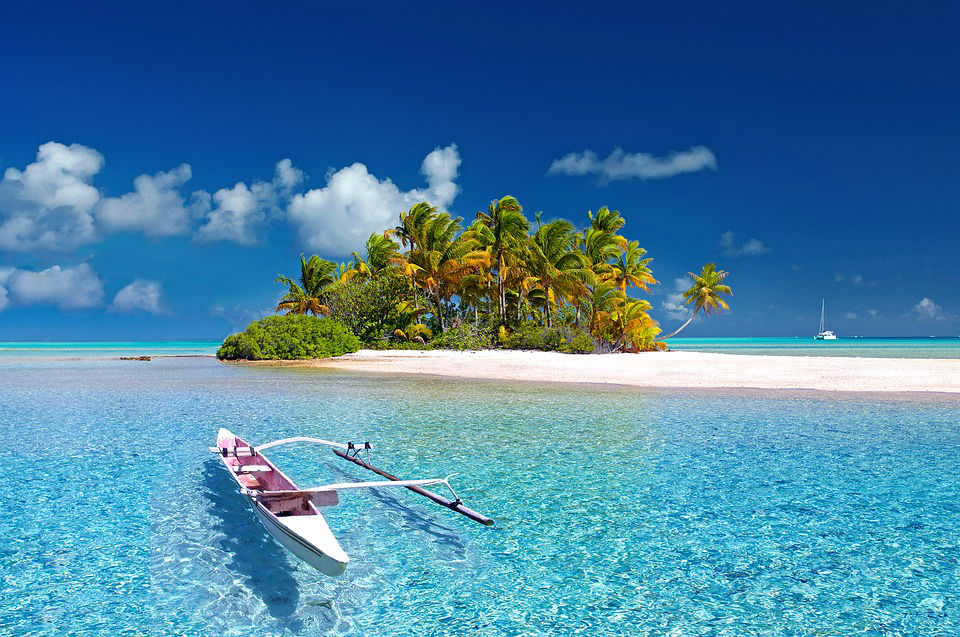
The scale is the part worth holding on to. The lagoon runs about 80 km long by 32 km wide, covering roughly 1,446 km², ringed by something in the order of 415 motu, islets and sandbars. Tahiti itself, all 1,045 km² of it, would fit inside that lagoon with room to spare. When people say the horizon disappears from the middle of it, that is arithmetic, not poetry.
Choose your village before you choose your room
Rangiroa has two inhabited villages and two passes, and they are not interchangeable. Avatoru holds the airport, the shops, the dive centres and the bulk of the beds. Tiputa, across the pass of the same name, is smaller and calmer, and you reach it by boat shuttle.
Staying on the Avatoru side means you can walk to a shop, hire a bike and reach a dive briefing without organising a crossing. Staying towards Tiputa buys you quiet and costs you spontaneity. Neither is better; they suit different weeks.
What kind of place to book
Accommodation on the atoll splits into three broad families, and the price gap between them is enormous. I would not tell you which specific property to pick, because I have not slept in all of them and I do not review beds I have not tested. What I can lay out is what each family gives you.
| Type of stay | What it typically includes | Who it suits |
|---|---|---|
| Resort with overwater or beach bungalows | Airport transfer, restaurant, spa, in-house dive partner, air conditioning | Honeymooners and anyone who wants nothing to organise |
| Small hotel or guest bungalows | Half board, hot water, a terrace on the lagoon, a handful of rooms | Divers doing two tanks a day who only need a bed and a meal |
| Family pension | Rooms in a local home, shared or private kitchen, meals with the family | Travellers on a budget, and anyone who came for the people as much as the water |
Two questions decide more than the star rating. Ask whether airport transfers are included, because there is no taxi rank waiting for you. And ask about the meal plan: independent restaurants are scarce and shops carry what the supply ship brought, so a kitchen or a half board arrangement is not a luxury here, it is logistics.
The diving is the reason most people come
The Tiputa pass is what put this atoll on the world map. A group of bottlenose dolphins lives in it all year round, and grey reef sharks, barracuda, jacks and turtles use the same current. It is drift diving in a tidal channel, so centres normally reserve it for divers who already have experience. The Avatoru pass, on the western side, is the gentler of the two.
Timing matters more than most people expect. The dry season runs May to October, with water and air around 25 to 27°C. Great hammerheads gather between January and April, manta rays are most likely between July and September, and migrating humpback whales pass roughly from early August to mid-October. Between June and August the maramu, the southeasterly wind, can rough up the sea and make some days harder.
What else fills a week
Beyond the passes, the lagoon excursions are full day affairs by boat, not afternoon strolls. The Blue Lagoon, a lagoon within the lagoon on the far rim, and the Sables Roses, the pink sand beaches at the eastern end, both involve serious crossings, so weather can cancel them. Book them early in your stay rather than on your last morning.
Then there is the thing nobody expects on a coral atoll: a working vineyard. The Domaine Dominique Auroy has grown vines on coral soil at Rangiroa since 1997, producing whites and rosés under the Vin de Tahiti name, and the cellar takes tasting bookings. It is a strange and genuinely memorable hour, and it makes for the least likely bottle you will bring home all year.
Before you book
Flights from Papeete take about an hour and several a day are scheduled, but seats fill fast in the July to August and December windows. Pack reef shoes, a dry bag and more reef-safe sunscreen than you think you need, because the shops are small and prices on an atoll reflect the freight. And accept the pace: this is a strip of coral one to two metres above the sea, a hundred metres wide in places, five thousand kilometres from the nearest continent. Nothing here moves quickly, which is precisely the point.
If what you are actually chasing is flat water and wind rather than what swims beneath it, our round-up of the best places to kiteboard covers that side of the tropics.
Distances, seasons and flight frequencies checked in August 2026. Schedules and prices in French Polynesia change often, so confirm them with the airline and your accommodation before you commit.
Stayed on the atoll?
Tell us which side of the pass you picked and whether you would do it again. First-hand reports from Rangiroa are rare, and they help the next reader book better.