People book it thinking it is an extreme sport, then come down slightly disappointed that it was so calm. That gap between what parasailing sounds like and what it actually is deserves clearing up before you hand over your money on a seafront.
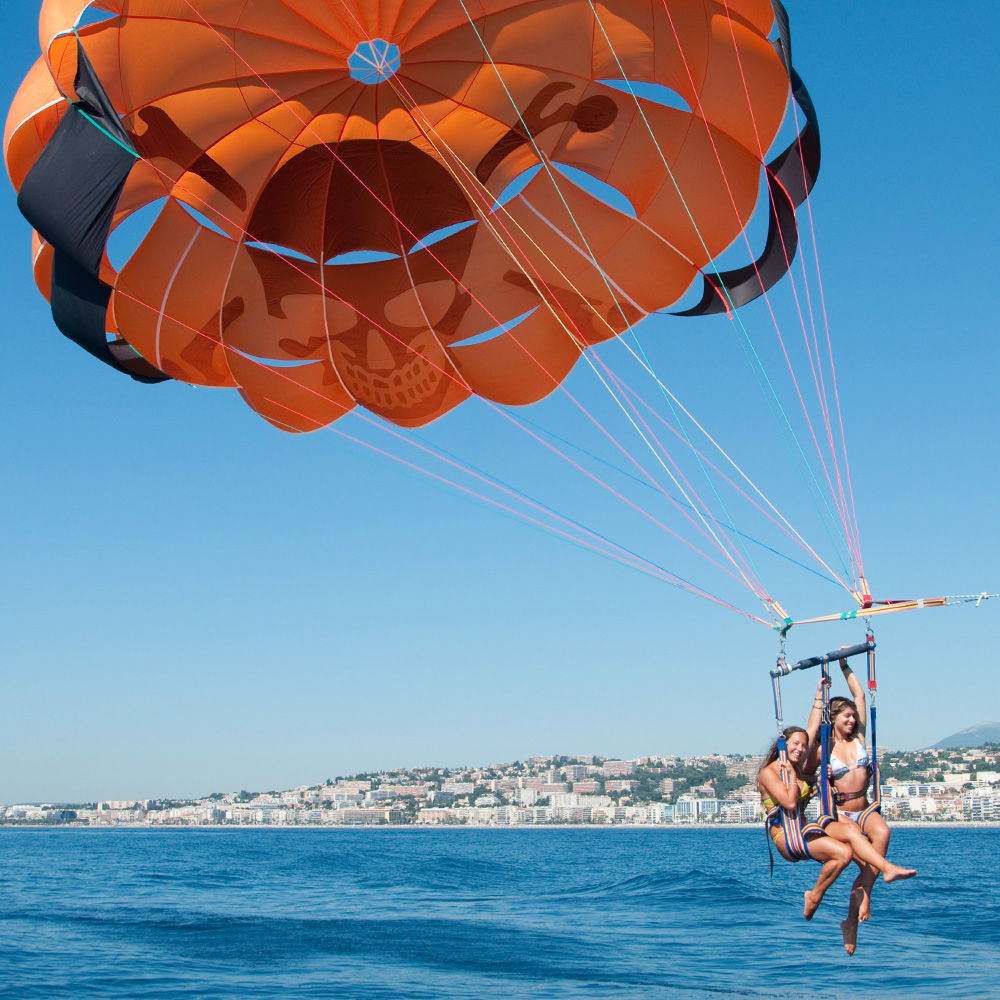
Parasailing is a boat ride you take in the air. A canopy is attached to a towline behind a powerboat, you sit in a harness under it, and the boat’s speed lifts you off and holds you there. You do not steer it, you do not jump from anything, and in France you are typically flying at a few dozen metres, not a few hundred. It is a sightseeing ride with a thrill attached, which is exactly why it works for almost everyone.
Quick takeaways
- You are towed, not launched. No piloting skill and no previous experience needed.
- Mandatory kit is a life jacket and a body harness clipped to the passenger towbar.
- French law requires two people aboard the towing boat: a driver and a spotter watching you.
- Flights usually last around ten minutes. Ask the operator what the price actually covers.
What parasailing is, and what it is not
Parasailing, parachute ascensionnel nautique in French, means being carried into the air under a canopy that is permanently attached to a boat by a towline. The canopy is not a parachute you deploy and it is not a paraglider you fly. Its shape and the boat’s forward speed do all the work, which is why an operator can put a nervous first-timer up there safely.
That also sets the ceiling on how wild it gets. Most people are content simply gliding in the breeze; some ask the driver for a dip, where the boat slows just enough to dunk your feet in the water on the way down before pulling you back up. That dip is the whole extreme-sport quotient of the activity, and you can decline it.
How a flight actually unfolds
The sequence rarely varies from one operator to the next, which is reassuring when you are standing on a pontoon wondering what you signed up for.
- Briefing and weather check. The crew decides whether conditions allow the flight. Wind, not sunshine, is what cancels a session.
- Kitting up. Life jacket first, then the body harness, fitted and checked by the crew rather than by you.
- Take-off. You are clipped to the passenger towbar and the boat accelerates. The canopy fills and you leave the deck, or the water, without any effort of your own.
- The flight. Several minutes of very little noise. This is the part nobody prepares you for: it is quiet up there.
- Landing. The winch brings you back down to the platform, usually dry, unless you asked otherwise.
Most first-timers report the same thing: the launch was far easier than they had imagined. One moment you are on the boat, the next you are simply up there, already sailing away behind it.
Not your typical holiday equipment
You fly in ordinary beach clothes, but two pieces of kit are not optional. The life jacket covers you if you end up in the water. The body harness works like a swing seat attached to either end of a passenger towbar, and it is what actually holds you in the air. Let the crew fit both. A harness adjusted by a passenger in a hurry is the one thing that turns a calm ride into an uncomfortable one.
The rules that apply in France
Parasailing here is a supervised commercial activity, not a free-for-all, and it is worth knowing what your operator is bound by. Establishments running it fall under the French Code du sport, with an insurance obligation set out in article L321-7 and general operating requirements from article R322-4 onwards. Paid instruction requires a specific state qualification, the BPJEPS in nautical activities with the parasailing endorsement, and the boats themselves are subject to an annual technical inspection under the 1984 maritime safety decree.
On the water, the safety rules for towed activities require two people aboard the boat, a driver and a second person whose job is to keep eyes on the person being towed. At sea, the applicable text depends on where you are: prefectural order 125/2013 for the Mediterranean, 97/2013 for the Channel and the North Sea, 2011/46 on the Atlantic coast. On inland water, the local mayor can regulate the activity directly.
Height is the question everyone asks. Specialised sources give a working ceiling of 50 metres for parasailing in France unless the local aviation authority agrees otherwise, and operators on the Riviera advertise flights in the 40 to 50 metre range. Since the figure varies by site and by prefectural order, treat it as a question for your operator rather than a national constant.
Who can go up
There is no single legal age or weight limit; each operator sets its own within the framework above. In practice, French providers commonly accept children from around five to eight years old when accompanied by an adult, allow solo flights from about sixteen, and cap total weight per flight in the region of 160 kg. On the Nice seafront, sessions of roughly ten minutes are typically advertised around 55 to 60 euros per person, checked in August 2026. Confirm both the limits and the price with the operator when you book, because these are commercial conditions and they move.
Enjoy an exceptional view
Location is what separates a good flight from a forgettable one, and this is where Nice earns its reputation. Taking off from the Baie des Anges, the bay that curves along the Promenade des Anglais, you get the whole city laid out in a few minutes: the seafront, the roofs of the old town, and on a clear run the Villefranche bay and the Saint Jean Cap-Ferrat headland further east. The more beautiful the scenery below you, the better the ride, and there are not many bays in Europe that reward a ten minute flight like this one.
Timing matters as much as the spot. If you are weighing up when in the year, and at what hour of the day, to book your flight, that is covered in our piece on when to try parasailing.
FAQ: parasailing basics and first-time tips
Do I need any experience to go parasailing?
No. You are towed by the boat and you have nothing to pilot. The crew handles take-off, altitude and landing, which is why operators can take complete beginners and children accompanied by an adult.
What safety equipment is required for parasailing?
A life jacket for water safety and a body harness that works like a swing seat attached to the passenger towbar. Both are provided and fitted by the crew. French rules also require a second crew member on board whose role is to watch the person being towed.
Will I get wet?
Only if you want to. Take-off and landing are normally done from the boat’s platform, dry. Some passengers ask the driver for a dip on the descent, where your feet or legs touch the water before the boat pulls you back up.
What cancels a flight?
Wind and sea state, far more often than rain. Operators check conditions before every session and will postpone rather than fly in a difficult breeze, so build a spare morning into your plans if you have only one chance.
Regulatory references and indicative prices checked in August 2026. Local prefectural orders, operator limits and prices change, so verify them with the provider before booking.
Flown over a bay somewhere?
Tell us where you took off, how high you went and what it cost. Honest reports from readers are how this site turns into a real directory for travellers.