
I booked three nights in Nice and stayed nine. That is the shortest honest summary of what this city does to a travel plan, and the rest of this article is me trying to explain why.
Three things make Nice worth a holiday rather than a stopover on the way to Cannes: a city centre that UNESCO put on the World Heritage List in 2021, a sea you can be swimming in within half an hour of landing, and an old town that still works as a neighbourhood instead of a stage set. The part nobody prints on a postcard is that the beaches are pebble, and that the second half of July onwards gets genuinely crowded.
Three reasons and one warning
- The listed area covers 522 hectares, so the sightseeing is the city itself rather than a checklist of monuments.
- Tram 2 links the airport to the middle of town, which removes the usual first-day transfer headache.
- Move one street back from the seafront and the same week costs a different amount of money.
- The beaches are smooth grey stones, not sand. Bring water shoes or accept a comic entry into the sea.
1. A cityscape that genuinely earned its UNESCO listing
In July 2021, UNESCO inscribed the city on the World Heritage List as Nice, Winter Resort Town of the Riviera. The listed perimeter runs to 522 hectares and takes in far more than the seafront: the Promenade des Anglais, yes, but also the leafy hillside quarters of Cimiez and Mont Boron and the villas and hotels scattered between them.
What is being protected is a piece of town planning rather than a single building. Nice was rebuilt from the late nineteenth century to receive wealthy northern Europeans for the winter, and roughly 150,000 of them arrived each season from Britain, Russia, Germany and Austria-Hungary. Once you know that, the oversized hotel façades and the palm avenues stop reading as decoration and start reading as infrastructure, built for a season that has since flipped from winter to summer.
Walk the Promenade early, before the heat and the crowds, carry on east to the working harbour at Port Lympia, then climb the Colline du Château. From the top you get the old town roofs on one side and the harbour on the other, which is the fastest way to understand how the two halves of the city fit together.
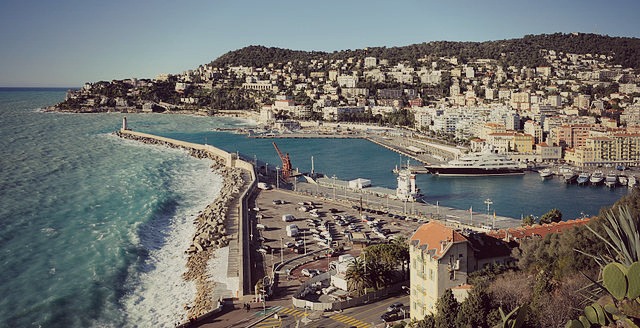
Nice port
2. The sea is close enough to change the shape of your days
Nice is one of very few Mediterranean cities where the water is a fifteen-minute walk from almost anywhere you would plausibly stay. That sounds like a detail. It is not. It means swimming stops being an outing you organise and becomes something you do twice a day, before breakfast and again at six when the light goes gold.
Getting there from the airport is equally painless. Tram line 2 runs from the terminals to Jean Médecin, in the commercial heart of the city, in roughly twenty to thirty minutes. It operates from about 05:24 to 00:15, a single ticket is priced at 1.70 €, and the machines at the airport sell a 10 € return valid in both directions. Those figures are the ones advertised for 2026 and fares do move, so check at the machine rather than trusting an article.
Now the honest part. Nice’s public beaches are galets, rounded grey pebbles, not sand. They are hot underfoot by eleven, awkward to walk on and unforgiving if you are carrying a child. Water shoes solve it for about ten euros. The private beach clubs along the Promenade solve it differently, hiring out loungers and mattresses by the day, which is comfortable and considerably more expensive.
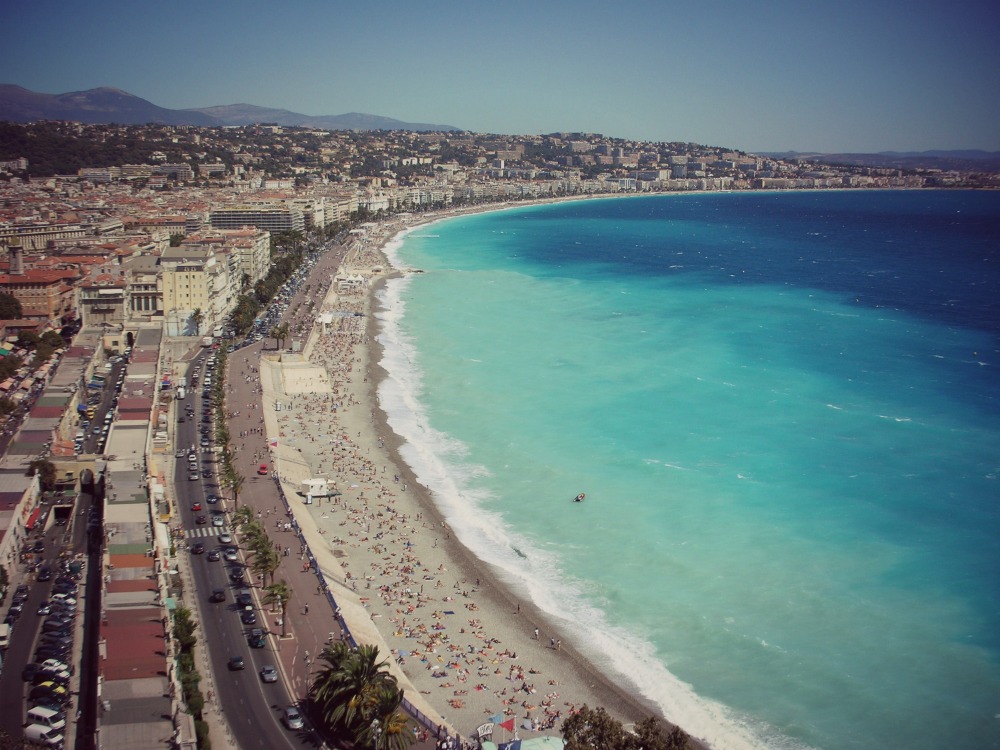
The beautiful sea on the French Riviera
3. It costs less than the Riviera’s reputation suggests
The Côte d’Azur has a reputation for prices that Nice itself does not entirely deserve. It is a real city, the fifth largest in France with 356,603 inhabitants at the 2022 census, complete with a university, a tram network and ordinary neighbourhoods, not a resort that empties in October. That is precisely what keeps a holiday here affordable in a way that Saint-Tropez in August is not.
The practical levers are simple. A holiday rental one street back from the seafront costs a different amount from one facing it, for a walk of ninety seconds. Travelling either side of the peak changes the figure again. And eating well here is cheap if you eat local: socca, the chickpea pancake sold hot by the slice, pissaladière, and the produce stalls of the Cours Saleya.
One scheduling trap worth knowing. The flower and produce market on the Cours Saleya runs Tuesday to Sunday and does not operate on Mondays, when the square is taken over instead by the marché à la brocante, an antiques and bric-a-brac market of around 180 dealers. Neither is worse than the other. They are just completely different mornings, so pick deliberately rather than turning up and being surprised.
If you want to see the coast rather than just the city, decide early how you will move. Trains and buses along the Riviera are cheap and slow, driving is faster and parking is a competitive sport, and some people go the other way entirely and rent a sport car for a weekend of coastal roads.
When to go, and what you give up
| Period | What it feels like | The trade-off |
|---|---|---|
| May to mid-June | Warm, long evenings, city still breathing | Sea still cool in May for most people |
| Mid-July to August | Full summer, every beach club open | Crowds, heat and the highest prices of the year |
| September to mid-October | Warmest sea of the year, thinner crowds | Autumn rain arrives suddenly and heavily |
| November to April | Mild, quiet, the original winter season | Swimming is off the table, some venues shut |
That last row is not a consolation prize. Winter is the season the city was actually designed for, and it is the reason the listing carries the words winter resort in its name. If the idea appeals, it is worth reading what the coast is like once the summer crowd goes home, because the French Riviera in winter is a genuinely different holiday rather than a diluted version of the same one.
Three things I would tell a first-timer
Do I need a car in Nice itself?
No, and it will work against you. The old town is pedestrian, parking is expensive and the tram covers the useful axes. Rent a car only for the days you plan to leave the city, and give it back afterwards.
Is it worth staying on the Promenade des Anglais?
Only if the view matters more to you than the money and the sleep. The seafront is a busy road as well as a promenade. Streets one or two blocks inland put you within a two-minute walk of the same water, usually quieter and usually cheaper.
How many days does Nice actually need?
Four is comfortable for the city on its own. Six or seven if you want to use it as a base for Monaco, Antibes and the hill villages, which is how most people end up using it whether they planned to or not.
Nice is the rare Riviera town that works as a destination and as a base at the same time. Come for the three reasons above, budget for pebbles and heat, and give yourself more nights than you first think you need. I did not, and I have been recommending the mistake ever since.
Last updated: August 2026. UNESCO inscription details are those published for the 2021 listing. The population figure is the 2022 INSEE census count. Tram fares and timetables are the figures advertised for 2026 and change regularly, so confirm them locally before you travel.
Been to Nice? Settle an argument for us
Pebbles: charming or unforgivable? Drop your verdict and your favourite corner of the old town in the comments, and tell us which month you went.