
Everyone who tells me they want to elope in Paris picks the backdrop first and looks at the paperwork last. That order is backwards, and it is the single thing worth sorting out before you book a flight or a photographer.
Paris hands you two very different days. A symbolic ceremony can happen almost anywhere in the city, with no residency condition attached. A legally binding marriage happens only at a mairie (town hall), and French law asks that at least one of you has lived in that commune for roughly 30 days before the banns are posted, with the banns themselves published at least 10 days ahead. Most couples flying in for a long weekend marry legally at home and keep Paris for the vows, the dress and the pictures.
- 1 The paperwork question, before you choose a backdrop
- 2 To elope under the Eiffel Tower
- 3 Eloping in Paris at Notre Dame Cathedral
- 4 Five more spots, and what each one actually gives you
- 5 The photo rule nobody warns you about
- 6 Questions couples keep asking me
- 7 Choosing well, rather than choosing the famous one
The paperwork question, before you choose a backdrop
A civil ceremony at the mairie is the only marriage France recognises as legal. Religious and symbolic ceremonies can follow, but they carry no legal weight on their own, which surprises a lot of visiting couples.
The residency rule is what catches people out, and it comes straight from the French Civil Code rather than from any town hall’s mood. Article 74 says the marriage is celebrated in the commune where one of the spouses, or one of their parents, has a domicile or a residence established by at least one month of continuous habitation on the date the banns are published. Article 64 then keeps the banns posted on the town hall door for ten days, and the ceremony cannot take place before the tenth day after publication. Add the two together and you are arriving in Paris around six weeks before the date. Because of that, most foreign couples handle the legal side at their own registry office and treat the Paris day as a symbolic elopement, which removes the residency clock, the sworn translations and a good chunk of the cost.
None of that spoils anything. It just decides what you are booking: a ceremony with a signature, or a ceremony with a view.
To elope under the Eiffel Tower
The Iron Lady is the backdrop almost every couple asks for first, and it still works, as long as you accept that you are sharing her. The trick is not the monument, it is the hour. Early morning on the Champ de Mars or in the gardens around the tower is a genuinely quiet place; the same square metre at four in the afternoon is a crowd.
Exchanging vows beside one of the small ornamental lakes nearby, or in one of the gardens that ring the tower, gives you the silhouette in every frame without putting a queue in the background.
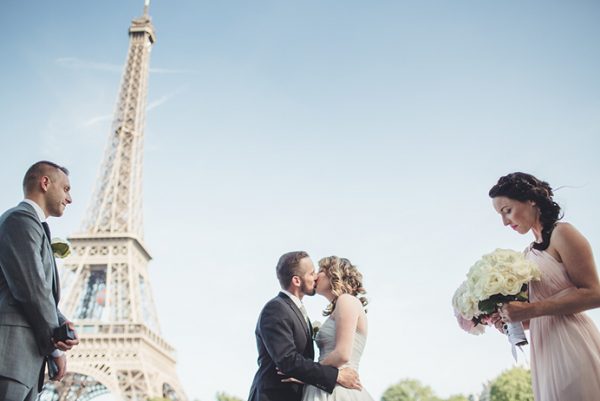
They just have said “yes” in front of The Eiffel Tower : what a wonderful point of view !
Eloping in Paris at Notre Dame Cathedral
Notre Dame reopened to the public on 8 December 2024 after five years of restoration, and the neighbourhood around it has changed as a result. The cathedral now draws well over 40,000 visitors on a busy day, with free timed slots bookable online, so the parvis in front of it is rarely the calm spot the photographs suggest.
What still works is the water. The Seine banks below the cathedral, and the quieter corners of the Île de la Cité away from the entrance, give you the same towers in frame with a fraction of the movement. Worth knowing before you plan: the gardens and the whole approach around the cathedral are due to be redeveloped from 2027, so check the layout close to your date rather than trusting an old photograph.
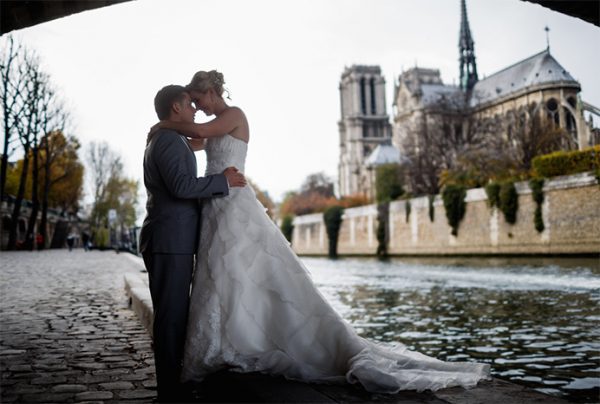
Notre Dame Cathedral is a marvelous and romantic background for eloping in Paris
Five more spots, and what each one actually gives you
Beyond the two headline monuments, Paris has a whole second tier of places that photograph beautifully and cost nothing to stand in. They are not interchangeable, so here is how they differ in practice.
| Spot | What you get | Best moment |
|---|---|---|
| Bir Hakeim Bridge | Steel arches, métro overhead, the tower framed down the deck | Sunrise, before the traffic and the film crews |
| Île Saint-Louis | Narrow streets, river on both sides, a village inside the city | Late afternoon, when the stone turns warm |
| Buttes Chaumont | Cliffs, a suspended bridge, a temple on a rock. The least Parisian looking of the lot | Weekday morning, it fills with locals at weekends |
| The Louvre and the Tuileries | Symmetry, the glass pyramid, formal gardens next door | First light in the courtyard, before opening |
| Montmartre and the Jardin des Plantes | Steep lanes and rooftops, or botanical calm with almost no tourists | Very early for Montmartre, any time for the garden |
The photo rule nobody warns you about
The Eiffel Tower’s night lighting is protected by copyright, and that protection has real consequences for what you do with your pictures afterwards. Photographing the illuminated tower for yourself, your family or your own social media is fine. Using a night shot of the lit tower commercially, on a paid website, in an advertisement or in anything monetised, requires prior authorisation from the company that operates the monument, SETE.
The tower itself, in daylight, has been out of copyright for a long time, so daytime images carry none of this baggage. If your photographer plans to sell or publish the set, it is a conversation worth having with them before the shoot, not after.
Questions couples keep asking me
Can we hold a symbolic ceremony anywhere in Paris?
In an open public park or on a riverbank, with a small group and no staging, nobody will stop you. A large setup, chairs, arches or a professional crew, is a different matter and normally needs permission from the site or from the city, so ask your officiant or planner who is responsible for clearing it.
Is a symbolic ceremony recognised back home?
No. It has no legal value in France and none abroad. That is precisely why couples do the registry office at home first, then fly out for the day they actually want to remember.
How many days should we allow?
For a symbolic elopement, three days is comfortable: one to arrive and see your spots at the right hour, one for the ceremony, one to be tourists. For a legal marriage at a Paris mairie, you are looking at six weeks in the commune, which is a completely different trip.
Choosing well, rather than choosing the famous one
The best elopement spot in Paris is rarely the one with the biggest name on it. It is the one you will still be able to walk back to in ten years without queuing, the one that matched your morning, your weather and the two of you. Paris has enough of those to make the choice hard, which is the good kind of problem to have on a trip. If you like this way of picking a place, I applied the same logic when I wrote about the most beautiful tourist destinations in Canada.
Legal and practical details checked in August 2026. Residency rules, opening arrangements and monument access change, so confirm them with the relevant mairie and with the monument itself before you fix a date.
Eloped in Paris yourself?
Tell us which spot you picked, what time you got there and whether it was as quiet as promised. Real timings from real couples are worth more than any list.
If you want the full wedding instead: choosing a destination