
Everybody sells the same photograph of a yacht on the Côte d’Azur. Almost nobody tells you that where you are allowed to drop the anchor has changed a great deal in the last few years, and that this now shapes the whole day more than the boat does.
Hiring a yacht on the Côte d’Azur gives you a coastline that has no road to it, a way to swim away from beaches that are packed from July onwards, and water sports launched straight off the back of the boat. What it also gives you, in 2026, is a set of anchoring rules built to protect the seabed. Understanding them before you book is the difference between a good week and an expensive argument with a patrol boat.
The short version
- Three formats exist: day charter, bareboat, crewed week. They suit completely different holidays.
- Anchoring on posidonia seagrass is banned along the French Mediterranean for vessels over 24 m, with fines reaching 150 000 €.
- Off Cannes, the Sainte-Anne mooring field north of Sainte-Marguerite replaces free anchoring on 43 hectares.
- For a bareboat charter you need a recognised qualification, and what counts varies by operator. Get it confirmed in writing.
Start by choosing the format, not the boat
The single most common mistake is falling for a photograph before deciding what kind of week you actually want. Three formats dominate this coast and they barely overlap.
| Format | Who it suits | What to watch |
|---|---|---|
| Day charter with skipper | First-timers, families, a single good day out | Fuel and mooring often billed on top of the day rate |
| Bareboat, you skipper it | Qualified sailors who want the boat to themselves | Licence acceptance, deposit, and who pays for damage |
| Crewed week | Groups, celebrations, anyone who wants zero logistics | The advertised fee is rarely the final invoice |
That third line deserves its own reading, because the way a crewed charter is priced surprises most people the first time. I went through the mechanics of it separately in the four honest reasons to travel by yacht, including what the quote leaves out.
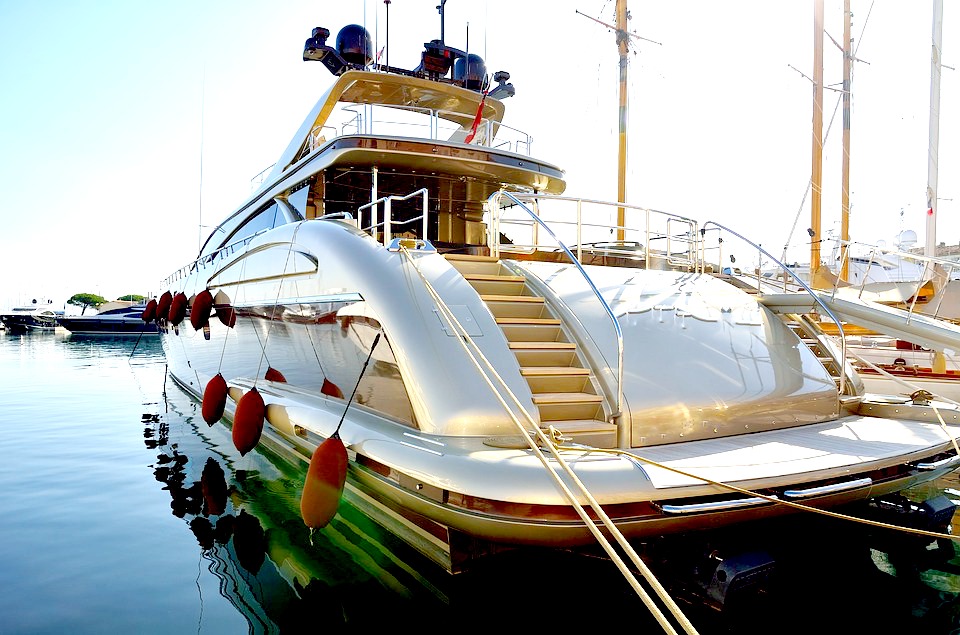
Is this what you dream of? Wait no longer, get on board a yacht to discover the Côte d’Azur in a different way
A coast that only makes sense from the water
The real argument for a boat here is geographical. A large share of this coastline has no road to it at all, and the parts that do have one are viewed from above, at speed, through a windscreen. From the water the relationship inverts: you look up at the cliffs of the Estérel instead of down at the sea, and the red rock against blue water is a completely different sight from below.
The obvious targets are the Îles de Lérins off Cannes, the calanques of the Estérel between Saint-Raphaël and Théoule, and the Cap d’Antibes. All three are busy by day and quiet after six, when the day boats head home and the anchorages empty. That gap between six and nine in the evening is the best thing a boat buys you on this coast, and it is invisible from land.
If your plan is to alternate nights afloat with nights ashore, it is worth pairing the route with the towns you would want to sleep in. There is a decent case for basing yourself in one of three Riviera towns and treating the boat as the day, rather than the other way round.
Where you can and cannot anchor, which is now the main constraint
This is the section most yacht articles skip, and it is the one that will actually affect your week. Beneath much of this coast lies Posidonia oceanica, a Mediterranean seagrass that grows a few centimetres a year and takes centuries to recover from a dragged anchor.
Under the prefectoral framework applying to the French Mediterranean, anchoring on posidonia beds is prohibited for vessels over 24 metres, with the zones clarified and tightened by successive decrees, the most recent significant update being decree 157/2024 of 23 May 2024. Penalties are not symbolic: fines reported in this context reach 150 000 €, and responsibility sits with the captain. Restricted areas are published on the Donia app and on the authorities’ Nav & Co app, and safety always takes precedence in bad weather.
Off Cannes the same logic has produced a concrete solution. A managed mooring field, the ZMEL of the anse Sainte-Anne, sits north of Île Sainte-Marguerite: 28 buoys for boats of 6 to 20 metres over 5 hectares, inside a wider 43-hectare zone where free anchoring is banned. It runs from 1 May to 30 September, arrivals are declared to the Moure Rouge harbour office on VHF channel 9, and use is capped at 7 consecutive nights and 21 nights per season so that the buoys keep circulating.
None of this is a reason not to go. It is a reason to ask your skipper or charter company, before you pay, exactly where they intend to stop and whether those spots are buoyed, permitted or off limits this season.
Water sports, without the beach
The practical joy of a charter is that the equipment is already aboard and the water around it is empty. Paddleboarding off the stern at eight in the morning, a swim in four metres of clear water with nobody within two hundred metres, water skiing in a bay that would be unusable from a public beach in August: this is the part that converts people.
Two things to settle in advance. Ask for the equipment list in writing, because it varies enormously from boat to boat and disappointment on the first morning is the most common complaint. And check what needs a licence and what the insurance actually covers, particularly for anything motorised.
Questions worth asking before you sign
Do I need a licence to charter bareboat in France?
Yes, for a motor yacht, and charter companies also require evidence of competence for sailing yachts. French operators commonly accept the International Certificate of Competence, which France recognises through UNECE Resolution 40. Beyond that, published guidance disagrees on which French qualifications are sufficient for which boats, so treat any blanket answer with suspicion and get written confirmation from your own operator for your own boat.
Is a sailing yacht or a motor boat better here?
It depends on what you want from the day rather than on the boat. Sail is quieter, slower and cheaper to run, and it suits people who enjoy the passage itself. A motor boat covers three anchorages in a day instead of one, which matters if your week is short and your list is long.
What about seasickness and wind?
Summer wind in the Mediterranean can rearrange a route at short notice, and a captain who changes plan because of it is doing the job correctly. If anyone in your group is worried, ask for a larger hull, keep the first day short and cross in the morning when the sea is usually calmest.
Hiring a yacht here is still the best way to see the Côte d’Azur, provided you treat the seabed as part of the planning rather than an afterthought. Choose the format first, ask where the boat is actually allowed to stop, and keep the evenings for yourself. The six o’clock exodus is the moment the whole coast becomes yours.
Last updated: August 2026. Anchoring restrictions, protected zones and mooring field rules are set by prefectoral decree and by local authorities, and they change from season to season. Verify the current rules and the ZMEL conditions with your charter company or the local harbour office before departure.
Chartered on this coast?
Tell us which anchorage still works in August and how your skipper handled the posidonia zones. Local knowledge in the comments is worth more than any brochure map.